Voglio recuperare Mercurio Loi, vado sul sito e clicco personaggi: non c’è nella lista principale. Ci sta, è una cosa minore. Clicco “tutto personaggi” che immagino dovrebbe essere “tutti” ma passi.
Su https://www.sergiobonelli.it/personaggi/ ci sono solo immagini quindi non è che puoi usare la ricerca testo del browser, devi scorrere la pagina a mano e cercare se c’è. Non c’è, o non lo vedo.
Ma bonelli ce l’ha una cosa digitale, no? Non la vedo nel menu e non è linkata nella pagina. Il link allo shop digitale sta nascosto sotto “abbonamenti“, perché evidentemente vendere cose non è il mestiere di Bonelli.
Sfido chiunque a sapere cosa è incluso nell’abbonamento digitale o quanto costa, da questa pagina. $DEITY $ANIMAL non c’è manco una call to action per comprare.
Per trovare il costo (€9.99 al mese) devi andare dalle FAQ e scoprire il link a https://shop.bonellidigitalclassic.com/ che ti dice il prezzo ma continua a non dirti cosa c’è nell’abbonamento.
Torno sul sito di digital classic, proviamo la ricerca “loi”.
Nessun risultato.
Ma perché? Chi ce li ha i diritti?
Costa troppo? Quanto? C’è la gente che fa gli scan gratis porco giuda non può essere una cosa proibitiva per chi ha già gli originali in digitale.
In 2026, after 16 years of Viktor Orbán ruling Hungary, we finally changed our government. This is a momentous change, and I think it’s worth explaining it a bit, as someone who’s been around the whole time.
The 2006 mess
I came to Hungary the first time in 2006. That year, Ferenc Gyurcsány was elected prime minister, but immediately after a confidential speech from him was leaked.
In the speech, he reprimanded his own people for not having done anything in their previous tenure at the government, and for having had to “lie in the morning, lie in the evening, and lie at night” to win the elections. It was supposed to be a motivational speech, “we must do better this time” kind of thing, but it backfired horribly.
People took to the streets1 (coinciding with the celebration of 50 years since the hungarian revolution), the government reacted poorly, opposition rode the protests and, finally, Gyurcsány resigned.
In 2010 new elections were held, and Fidesz won 263 parliamentary seats out of 386, which gave it a super majority and the ability to enact reforms without any cooperation with the other parties .
Just a new government
It’s fair to say that very reasonable people voted for Fidesz in 2010. Few liked or trusted the people who had been in power before, and Viktor Orbán had been one of the “young democrats” (that’s what Fidesz means) who opposed the communist regime in the late 80s and 90s.
Plus, between 2008 and 2010 Europe faced the one-two punches of the Great Financial Crisis and the Eurozone Crisis, so the opposition had a very easy play in blaming the government.
Arguably, Fidesz did a decent job in stabilizing the economy and the exchange rate of the Hungarian forint. Orbán also enacted some populist measures which won him quite some… popularity.
For example, many hungarians had contracted loans in foreign currency (EUR and CHF) but when the forint exchange rate collapsed they found themselves with unmanageable debts. The government passed a law to force banks to keep the favourable exchange rate, which helped avoid a real estate market collapse and directly helped many families. Some free market fundamentalists screamed that banks would go bankrupt or close shop and move, but basically nothing like that happened. Chart one up for populism.
At the same time, the government enacted some policies to balance out the books by “stealing from the future“, such as the nationalization of private pensions. Some of the intelligentsia complained, but not loud enough to matter.
2010-2014: the start of a regime
But the new majority also started taking steps to consolidate their power.
In 2010, the Parliament set up a new “media council” to oversee all media, with members elected by the parliament (so, chosen by Fidesz) and with the ability to impose massive fines and to revoke broadcasting licenses.
In 2011, the government amended the hungarian constitution, known as the Fundamental Law. There were many changes which were criticized on ideological points (mentioning christian roots, discharging responsibility during the nazifascist era, enshrinement of conservative values etc) but also some substantial changes to the state.
Among other things, hungarians abroad (large communities exist in Romania, Serbia, Slovakia) received citizenship and right of vote. They have been massive supporters of Fidesz since.
What’s important is also that the changes were drafted quickly and ignoring input from the opposition or external bodies. This was a testing ground, and Orbán saw it could push through stuff without major problems.
The government also changed the electoral regulations: Parliament was reduced from 386 to 199 seats, a first-past-the-post system was established, and the government re-drew constituencies in their favor, because gerrymandering is a temptation no government has ever refrained from.
In 2012, the Constitutional Court struck down some legislation by Fidesz, and the government reacted by changing the constitution again.
The 2013 reform, among other things, restricted the Court from using case law from before the 2011 amendments. AKA: judge us by our rules, not by yours.
In 2014, elections were held again: In 2010, Fidesz got 53% of votes, and this granted them 68% of the parliamentary seats. Four years later, they got only 44% of the votes but this gave them 69% of the parliament. You got to love FPTP.
The illiberal democracy
I know reasonable people who voted for Fidesz in 2014. He had done well with the economy, and the opposition didn’t really feel like “new faces”, as it went ahead with many of the people from previous governments and parties. For a decade, Fidesz has been able to run campaigns based on the fact that the opposition was always Gyurcsány.
Anyway, Fidesz won again. Some time later, Viktor Orbán gave an often cited speech in which he said “the new state we are constructing in Hungary is an illiberal state, a non-liberal state“.
The idea is a bit more complex than the soundbite, and I would encourage you to read the speech in its entirety (albeit translated).
I think it’s worth at least considering some of what he was saying
the most popular topic in thinking today is trying to understand how systems that are not Western, not liberal, not liberal democracies and perhaps not even democracies, can nevertheless make their nations successful. The stars of the international analysts today are Singapore, China, India, Russia and Turkey. And I think that our political community recognised and touched on this challenge correctly several years ago and perhaps also succeeded in processing it intellectually, and if I think back on what we have done over the past four years and what we will be doing during the upcoming four years, then things can indeed be interpreted from this perspective. Meaning that, while breaking with the dogmas and ideologies that have been adopted by the West and keeping ourselves independent from them, we are trying to find the form of community organisation, the new Hungarian state, which is capable of making our community competitive in the great global race for decades to come.
Viktor Orbán, 2014
2014-2018: entrenchment
Fidesz had by this point become a personal party, and the system of clientele/patronage/corruption in public procurement was bearing greater and greater fruits. There’s a nice documentary from the Hungarian journalistic NGO Direkt36 which explains how the Orbán family got richer and richer.
In 2015, Orbán got the chance of a lifetime: the refugee crisis in Europe, when a ton of people from Syria and other places came to Europe.
The Serbia/Hungary border was on a common route, and Orbán caught the chance to ride the crisis, show himself as a strong and picture the EU as the enemy. A massive propaganda campaign kept picturing the EU as forcing Hungary to accept refugees (which, for the most part, just wanted to get to Germany or Austria and didn’t give a shit about staying here).
By the existing EU accords they should have hosted a few thousand refugees in the end and simply registered the others (or ignore them as they always did) but the government managed to picture “the invasion” as an existential threat.
In 2016, the government held a referendum on the question “Do you want the European Union to decide, without the consent of the Hungarian Parliament, that people other than those with Hungarian citizenship should be settled in Hungary?”.
It got 98% approval.
This kind of plebiscitarian votes became a constant in the following years. Each phrased in the most inflaming way, and each completely pointless, as only Fidesz hardcore voters bothered to participate.
It’s during this period that Orbán built up the EU and the “western liberals” 2 as the main enemy of the proud hungarian nation.
It was easy! Fidesz and their friends had taken control of most media, controlling all of the TVs (which means all of the old people), radio, most press and many internet outlets. Constantly, there were propaganda posters paid by the government or by think tanks, foundations etc..
A friend saw a small kid crying at the playground because he was afraid of the migrants.
2018 propaganda poster from the government: “Soros wants to move here millions from Africa and the Middle East: STOP SOROS”
2018-2022: cracks appear
The government kept playing the “bad EU card”, and the “Gyurcsány is the opposition” for years.
Ironically, the EU did nothing against Fidesz in all this time3. They made some noise every time the government slipped a bit more but the EPP cherished those sweet EMP votes from Fidesz, until 2021.
The rest of the Europe did just as bad as the EU institutions. German companies kept opening factories and offices in Hungary. Budapest tourism was booming. UEFA was very happy with the new stadiums4 and keeps assigning finals to play there.
2018 had the highest turn out at elections since 2006 (~70%), showing that people were at least making an attempt to change the government. But still, Fidesz won 49% of the popular vote, and 67% of the seats.
In 2020, bam, we got COVID and “emergency measures”. The government gave himself even more power, and never gave it up again.
It is during this mandate that Orbán switched more prominently to the talking point of the “gen z right“: alignment with Russia, extreme opposition to LGBTQ rights (which had not been a major issue previously), stigmatization of NGOs as “foreign agents” etc..
At this point in time there were pretty large protest by teachers asking for a better salary. For me, an Italian, the idea that there are not enough teachers in Hungary was striking, in my home country people wait for years to become one. The main reason is, of course, that Hungarian teachers are wildly underpaid and can barely survive on their salary in big cities.
With post-covid inflation pushing prices wildly up (double digit inflation for years), and with real estate prices ballooning, people started to feel the pressure of a decade of wasted resources: Hungary had fallen from being one of the richest countries in the region to one of the poorest.
The opposition finally managed to get their shit together, and they ran as a single union of all opposing parties5 , with primaries to choose candidates and leadership, and fielding a somewhat independent candidate who had previously beaten Fidesz in some local elections.
This gave some hope to people, especially because the same playbook worked to win the Budapest Mayoral/Council election in 2019.
But this time it didn’t. Fidesz got 49% of the votes and most of the parliament seats, again. Personally, I believe the candidate, Péter Márki-Zay, had the charisma of a bathtub duck (which makes you think about what the opposition primaries were like), but you can think what you want of the cause for the loss.
2022-2024: people get fed up
In 2023, the government passed the so called “revenge law“, a law that worsened working conditions for teachers, with no apparent benefit to anyone. This was vastly interpreted as a form of punishment for lèse-majesté.
Among other things, still relying on the emergency powers coming from 2020, the law restricted the ability of teachers to go on a strike unless they could guarantee that classes were held, nullifying the meaning of a strike.
The EU and some european partners had finally awaken to the fact that Hungary was a pain in the neck, but it was impossible to act against it because Poland, ruled by another right-wing coalition, would block any significant move. After a long time, it started to freeze EU funds. Very little, very late.
Russia’s invasion of Ukraine gave the government more propaganda ammo: the West was obviously interested in war, while Hungary stood alone on the side of peace and compromise.
This new narrative worked on some people who really feared war at their door, but many older Hungarians (the cornerstone of Fidesz base) still distrust Russia for obvious historical reasons so the propaganda was less successful then previous ones.
This leads us to the events of 2024 and then 2026. But I realize this post is far too long, and it’s been in draft for months, and I will post it now, and there will be a follow up.
If I remembered anything wrongly, please correct me, and see you soon.
I had a front row on the protests as I was living downtown. The protests lasted a long time but with minimal damage to people or things, I’ve seen worse at football games. ↩︎
It will always be hilarious that one of the scarecrows of Fidesz was Soros, who’s actually Hungarian, and who financed a scholarship for Viktor Orbán in the ’90s to study in the UK. ↩︎
It is a recurring meme in hungarian political discussion that the government spent way more money on football stadiums than it did in healthcare and education. ↩︎
Technically, there was also a far right party, Mi Hazank (“Our Homeland”) which had split from another far right party, Jobbik (“Better” but also “jobb” also means “right” so “More To The Right”, it’s a brilliant name). Ironically, the original Jobbik was further right than Fidesz, but Fidesz’ shift over the years meant they were now the moderate right. ↩︎
I rewatched The Hunt For Red October this week1, and I noticed Tim Curry was in it. I somehow thought he had died already, and then, the next day, he actually did.
A lot of actors from that movie have died. Sean Connery, Sam Neill, James Earl Jones, surely more whose name I don’t remember, or never knew. This is a factor of the movie being released in 1990, 36 years ago, we’re all getting closer to that meet cute with the scythe dude.
Anyway, I had never realized before that Tim Curry was in it. Because Tim Curry was in everything. For a long time I couldn’t recognize him even tho I liked all his characters, and I find it ironic that just before he died, I did recognize him.
I recall the time when I first noticed Tim Curry was cast in roles so vastly different as to be unrecognizeable, and I started paying a bit more attention.
Cardinal Richelieu in The Three Musketeers is cunning and ruthless, Pennywise in the It miniseries is terrifying, Dr. Thornton Poole in Oscar2 is awkward and hilarious, the wizard Ymper Trymon in The Colour of Magic is sinister but ironic. Heck, I only realized he played Darkness in Legend yesterday, a movie I have not seen in 30+ years, and I am still scared of him. Do you see how far away from each other all those characters are?
I cannot overstate how much I was blown away by watching the movie3. In fact, my online presence is generally named riffraff after the character in this show. To be honest, I didn’t know that riffraff was a real word4, I just liked the sound of it. I still do, so it was a good choice.
Tim Curry’s performance is incredible. He’s mesmerizing, he’s magnetic, he’s got a fantastic singing voice. He was, in my deeply personal opinion, ugly as hell5, but he’s got so much charisma that you can easily believe he’s a supernatural being who’ll have no trouble seducing the protagonists. And he’s good at walking in high heels!
So, goodbye Tim. I will spend the next decades (hopefully!) of my life looking out for your presence among the cast, and when I’ll notice I’ll say “oh wow, that’s Tim Curry! He had so much breadth in his performances!” like I’ve been doing for the last twenty years or so. And I’ll be a little happy, and a little sad.
It’s a fantastic movie, and watching it I realized that while it is presented as a spy thriller it is, in my opinion, an action movie, except the action is carried out by submarines instead of car chases. Man, I love this movie. ↩︎
Oscar is a brilliant comedy, and I fail to think of another actor who could have played Dr. Poole like he did. I can’t understand how this movie is not more popular. ↩︎
I have never seen the actual theatre production, it’s on my bucket list. ↩︎
riffraff /rĭf′răf″/ noun: people regarded as disreputable or worthless. ↩︎
and yet, yesterday I saw someone saying “oh he was so attractive in RHPS!” ↩︎
Io non ho letto molto di Dino Buzzati, ma sono convinto che Sessanta Racconti sia un capolavoro assoluto, quindi quando ho scoperto che aveva scritto un romanzo “a fumetti” mi sono affrettato a comprarlo.
la copertina dell’edizione 2017 del libro, credo
Buzzati e fumetti
Apparentemente Dino Buzzati era un appassionato di fumetti. Una sua frase spesso citata è che i personaggi disneyani valessero tanto quanto quello di scrittori più rispettati.
“La loro statura [di Paperino e Paperon de Paperoni], umanamente parlando, non mi sembra inferiore a quella dei famosi personaggi di Molière, o di Goldoni, o di Balzac, o di Dickens.”
Dino Buzzati
È anche noto che fosse un avido lettore di Diabolik, e che fosse solito mollare libri noiosi rivolgendosi alla moglie con un “dai, passami Diabolik“.
Essendo anche un artista visuale non stupisce che abbia deciso, a un certo punto, di cimentarsi in questa arte mista di parole e immagini.
Poema sì, fumetto boh
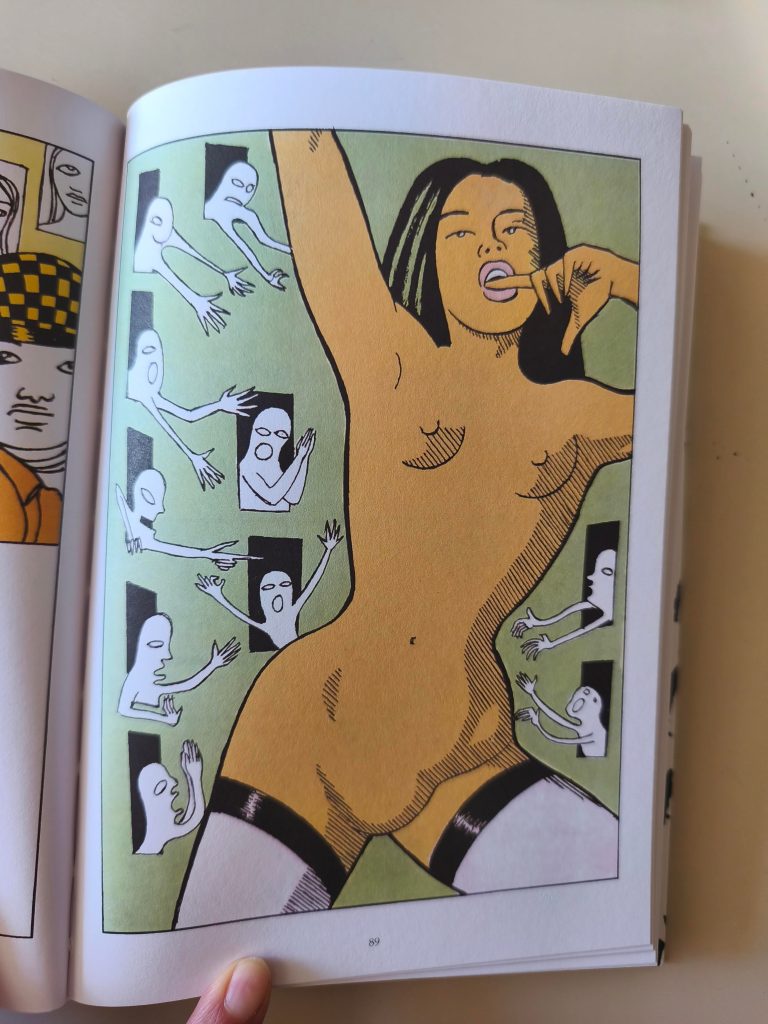
Quando uno pensa “fumetto” gli viene in mente la nuvoletta. Di nuvolette, in questo libro ce ne sono forse una manciata. Quindi non so se sia un fumetto.
Ma Caro Lettore, sono disposto ad accettare che ci sono fior di fumetti senza la nuvoletta eponima. A me è sempre piaciuta molto l’idea di fumetto come sequential art, per esempio.
Però, ecco, anche da questo punto di vista, questo non è un fumetto, per la semplice ragione che la maggior parte dei disegni non è in dialogo con il disegno prima e dopo, se non raramente. È come se l’autore non avesse digerito la grammatica del fumetto, pur azzeccandone l’ortografia.
una delle rare tavole che sembra più un fumetto
Quindi secondo me, è un libro illustrato, punto. Altrimenti dovremmo considerare fumettista pure William Blake. Va detto che il titolo originale era “La Cara Morte“, quindi magari incolpiamo il titolo, infedele fin da principio.
E il poema, com’è?
Il poema rivisita la storia di Orfeo ed Euridice, in salsa ’60 (Orfi è un musicista amato dalle ragazzine) e parte pure un po’ banalotto. Ma subito se ne allontana per fare una lunga discussione su cosa sia l’aldilà davvero, e non faccio spoiler oltre il titolo originale.
È un libro in qualche modo angosciante e triste, come tante storie di Buzzati, ma è bello e si legge con facilità, come tante storie di Buzzati.
Anche qui, non sono sicuro sia un poema, in quanto non sembra neanche in versi. Ma boh.
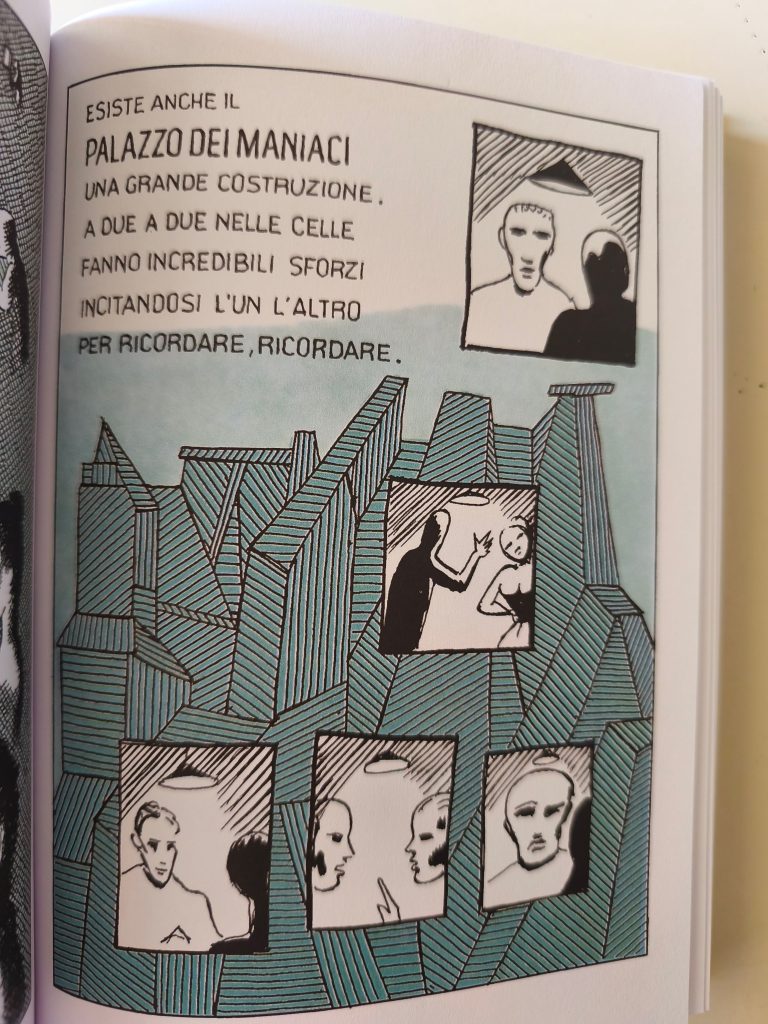
Direi che le parti più riuscite e gradevoli (per me) sono quando l’autore si dedica a descrivere parti dell’inferno o a fare quadretti di micro-storie
una delle micro-storie, pronta per l’era social
D’altro canto, la narrazione in sé, se pur soddisfacente, non mi è parsa particolarmente brillante. Ma è comunque una variazione validissima su di un tema trattato infinite volte.
E l’illustrazione, comè?
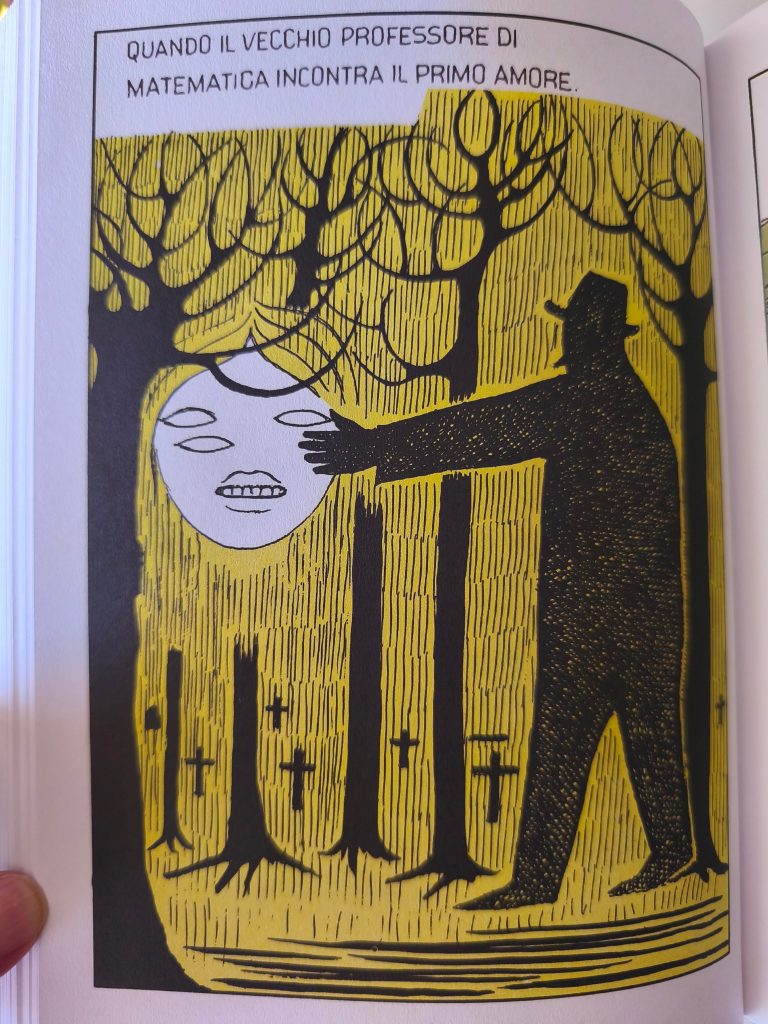
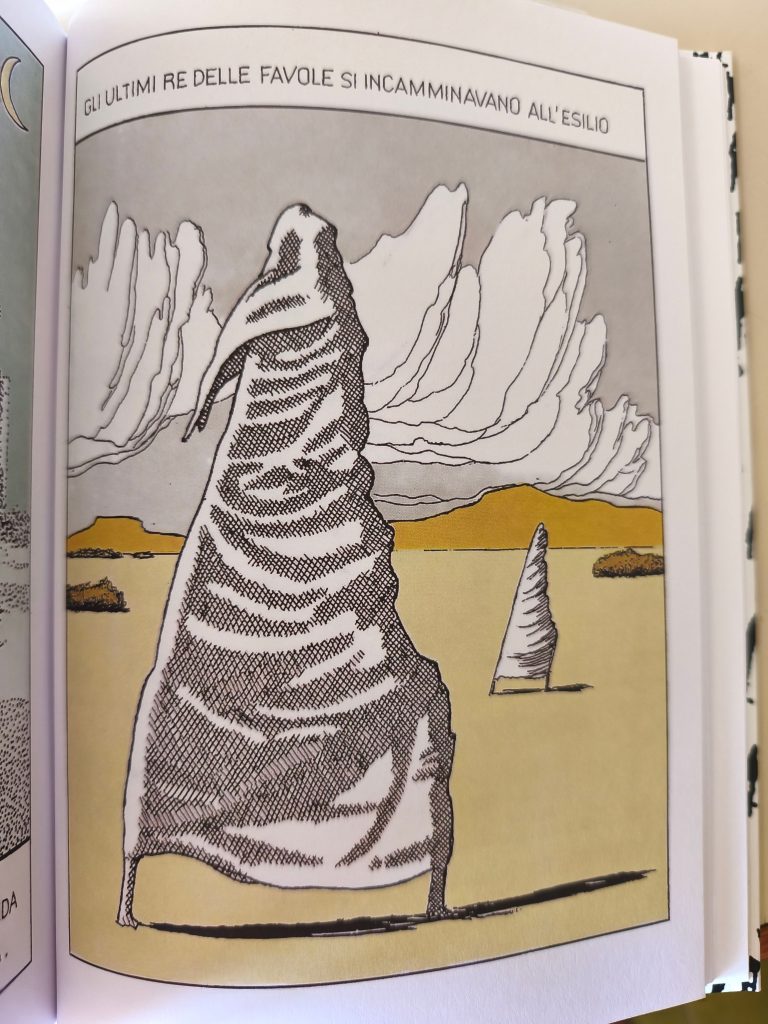
È bella e strana. In ogni momenti si ha la sensazione di vedere qualcosa di familiare, perché, apparentemente, l’autore si è ispirato spesso a immagini di riviste, o ad opere d’arte esistenti. Alcune sono citate esplicitamente e quasi ovvie (Dalì e De Chirico in primis). Altre sono recuperate nell’ottima introduzione di Lorenzo Viganò.
Si crea una specie di gioco in cui ad ogni immagine ti chiedi cosa tu stia vedendo e cosa ti ricordi.
un disegno ripreso da Buzzati stesso come opera a sé stante, “I maghi d’autunno“
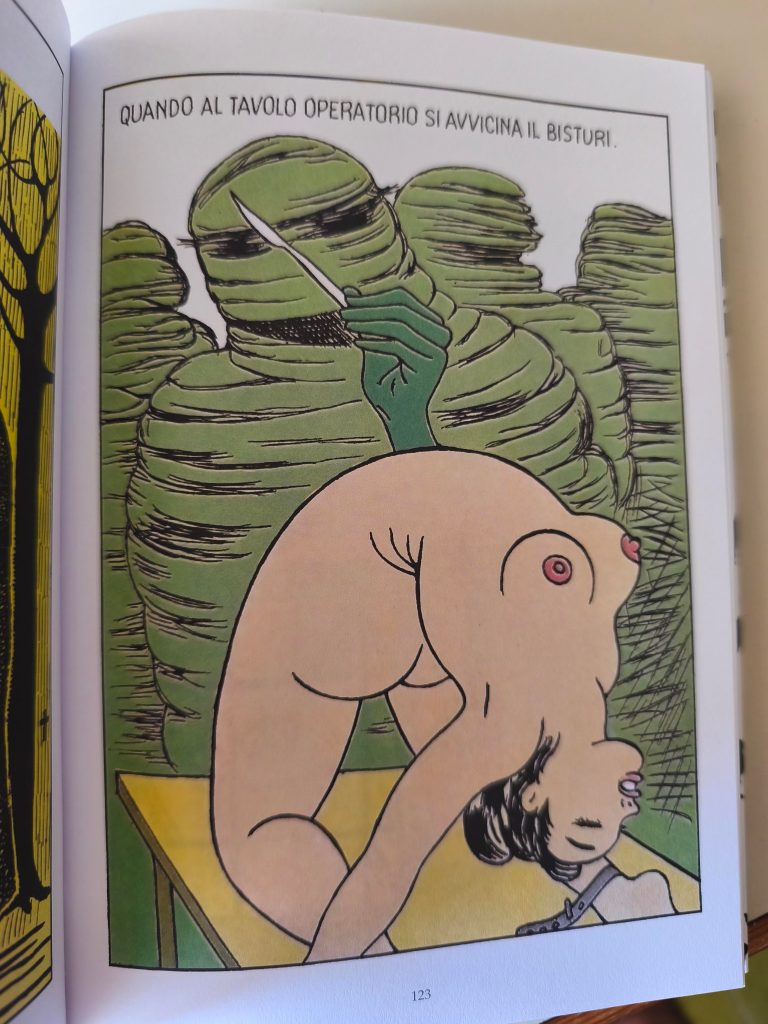
È anche un libro con una marea di donne nude. Non so se fosse il periodo, o se il buon Dino avesse una certa vena voyeur da soddisfare, e ovviamente il tema inferno/diavolesse/tentazione per un uomo nato nel 1906 è abbastanza ovvio che sia visto così.
Ad ogni modo, tra le donne nude, ho trovato interessanti due cose.
Primo, che i disegni di donna sono quanto di più lontano dalla donna fumetto stereotipica, sia essa Supergirl, Eva Kant, Motoko Kusanagi o Satanik. Le donne sono morbide e fisiche. Il che ha senso quando uno capisce che sono state disegnate partendo da fotografie (da riviste, o fatte dall’autore stesso).
I riferimenti a certa fotografia o arte erotica sono abbastanza chiari. O ce la vedo solo io Bettie Page?
Secondo è interessante che l’autore si diverta a presentare tante “perversioni” tra giarrettiere, BDSM, necrofilia ed altro, ma siccome sono gli anni ’60, si possono disegnare donne nude, vedere scene erotiche al cinema, ma per qualche ragione è impossibile far vedere l’organo genitale femminile§.
Mi è piaciuto così tanto Poema a fumetti che vorrei discutere tutte le tavole. Magari un giorno mi ci metto, ma sono in viaggio e ho dovuto lasciare il libro in un’altra casa, quindi non lo farò oggi§.
Caro Lettore, c’è qualcos’altro di cui volevo parlarti, ma me ne sono già dimenticato, e questo post è già troppo lungo. Magari mi verrà in mente quando rileggerò questo volume, e ci farò un altro post.
Voto 9, si può leggere in un paio d’ore o in un paio d’anni ed è bello comunque
So when I discovered she wrote a book about climate change, pollution, and the other problems affecting our dear planet, I was quite happy to read it.
Well, to listen to the audiobook. I think non-fiction pop-sciencey books work great as audiobooks, as the authors tend to repeat the same thing over and over and over, otherwise the book would be summed up in an blog post. In this case, I think the author herself is reading the book, which I appreciate from a philosophical point of view, but I found the accent a bit hard to understand at times.
In short, the book talks of a lot of issues currently affecting the planet, but unlike many of this kind, it has a positive look at them, because things are bad, but they’re better than they were, and they can improve more. A desperate look at things, is just as bad as one that trivializes issues. We can do better, and humankind we already managed to fix some large issues.
See, I’m from the ’80s, I grew up with the perspective of losing the ozone layer, and having to apply a pint of sunblock 5000 to stay in the sun. Also, do you remember when acid rains were a constant threat? Or actually seeing the exhaust smoke while in a line of cars? Those are things of the past, in most places! You would be crazy if you looked at things and didn’t see that we can improve and we did it in the past.
Anyway, The book is split in chapters, but the theme is basically the same on all of them, things are bad, but getting better, and there’s things you can do which matter quite a bit and things that matter very little. The chapters are:
Sustainability
Air Pollution
Climate Change
Deforestation
Food
Biodiversity Loss
Ocean Plastics
Overfishing
Most of the things she says I was already familiar with, but may be shocking the first time you hear of them. For example the fact that we already produce enough food to feed everyone on the planet (if we could convince everyone to eat vegetables, and stop using a lot of it as fuel).
The book is pretty pragmatic in suggestions too. A major root cause for many problems is, for example, beef production. The author knows she won’t convince the world to go vegan, so she just points out that, if you can choose, reducing your beef intake is probably the best thing you can do to help with a bunch of issues. If you want to eat meat, just cut a. bit, or prefer smaller animals (chicken is better than pork which is better than beef).
She also tries to slay some misconception, such as the idea that locally produced things are strictly better. They may be from a social standpoint, but they may not from a sustainability point of view. A box of avocados from south america are still better for the environment than a locally sourced steak in Europe.
And I appreciate how she points out that many of the things we consider green cosplay, such as avoiding single use plastic bottles or bags, are actually.. well, not that important. Yes, prefer a reusable tote bag for groceries, but the actual impact of a plastic bag is not that terrible, you shouldn’t feel guilty if you occasionally buy one, or if you get a bottle of soda from a vending machine.
Overall, I enjoyed the book. I think the author lets a few things through without actually explaining them. For example, she is in favor of building new nuclear plants, and while I’m 100% in favor of keeping old plants running and investing in new research, I am not sure the numbers come out in favor of new plants at this point in time. I may be wrong, but I would like to see her preference argued for with numbers, rather than background “bias”.
Vote 7/10: great book if you never heard these arguments, good book otherwise.
I recently read the third book in The Dark Profit Saga series of books. I was sure I wrote reviews of the first two, but apparently I didn’t. So here’s an aggregate one.
This series of books started out as a kind of comedic fantasy take on the Great Financial Crisis, with the book Orconomics.
The books stick to a standard cliché D&D fantasy world (orcs, goblins, halflings, nagas, gnolls etc) but inject our world’s financial system and society into it.
So, for example, quest runs are financed by investors in exchange for portions of the loot. This in turns means there is a market for stuff like dragon hoard futures, insurance, derivatives (CTO are “collateralized threat obligations“) etc etc.
The first book’s subtitle is “a satire” and it’s a pretty harsh one. The criticism of our economic reality is hard and transparent. The criticism of our society is just as bad: there’s a downtrodden population, the shadowkin, which can be killed and looted, unless they have special papers to be accepted into “proper” society… except those still won’t grant them proper standing (e.g. a subplot follows the murdering and looting of an innocent gnoll for a minor infraction and the lack of judicial consequences). Drug addiction, stereotyping, sexism, religion. Perhaps even too much stuff.
Overall, I found the first book quite funny, so I followed up with Son of a Liche and finally with Dragonfired. I think over time the author moved a bit from “easy” irony which you may appreciate or not
I would say the irony is rarely as clever as the best Terry Pratchett, but it matches the early Discworld stuff.
I find the D&D setting uninteresting, but the author turned it upside down enough that it becomes entertaining (such as the Orcs trying to integrate into lightling society by moving from raids and pillage to The Path of The Aggressive Seller).
The abundance of puns, especially in the first and second book, is just very entertaining for me, at least once I noticed it. Off the top of my head, with mapping in footnotes (so you can feel clever too!)
A bunch more references can be noticed (if you pay attention) to games, movies and other things from our own world. Again, not as thick are deep as Terry Pratchett, but enough to cause you a giggle when you notice it.
The books also have genuinely good plots, and the author has a penchant for that trick of connecting sentences across scenes which I find delightful and very cinematographic.
I am not sure what the name of this thing is, but imagine something like the party opening some dungeon door and staring, one character goes “Oh Gods is that ..” then a quick cut to different people at the bar where one says “That’s a pile of bullshit“.
I looked up an example, tho it doesn’t make much sense without context
The bolt hit home before the thought did, punching into Oopa’s back with enough force to flip her over in midair.
Something pink and bright flitted past her face as the messenger sprite flew above her, speeding off toward its destination.
Then she rolled in the air again and lost sight of her final message. Trailing blood, she plummeted toward the dark water below.
<chapter break>
The crimson olive dropped into the amber liquid with a faint plop.
Perhaps these are cheap writing tricks, but I like them.
One important mention: I listened to all these as audiobooks, and the narration by Doug Tisdale Jr. is excellent (if you enjoy narrators that do different voices for all the characters).
There’s a fourth book out, perhaps I’ll manage to post a single review for that one, meanwhile
Votes:
Orconomics: 7 quite funny and original, tho a bit cheap on irony.
Son of a Liche: 6.5 less slapstick but also inspired, perhaps.
Dragonfired: 7 less funny overall, but somehow feels like it has more heart.
Some time ago I came upon someone asking what would be a good introduction to the Arthurian cycle and the matter of Britain, and the replies mentioned that this book would be a good one that covered “most of it“.
Dear Reader, if you have been here me for a while you’ll know I am deeply lazy and love “most of it” works, so this piqued my interest.
I am glad it did cause this book was very good, and also extremely odd, but in a good way. Mild spoilers ahead.
The book was actually multiple shorter novels published separately and then bound together in a single volume, and while there is some unity, they read quite differently.
What’s in the books
First, let me mention this: did you see the 1960s “The Sword in the Stone” animated movie from Disney? The one where they turn into squirrels and flirt with other squirrels? The one with the magic battle where they turn into animals and such?
Well, that’s the first book in this saga. Almost all of the movie is from the book. This isn’t Disney making a crab jamaican, it’s 90% White’s imagination.
And the whole saga has all the same character the movie does! It has a ton of anachronisms, Merlyn is a time traveling savant with a bad memory, badgers and urchins (hedgehogs) discuss political systems, Guenevere and Lancelot argue as an old couple (I loved the fact that Lancelot and Arthur call her “Jenny“), the fearsome Questing Beast has to be nursed back into health after falling in love with two knights in a costume (a scene worthy of Laurel & Hardy!). And there is so much more beyond the comedy.
The second book contains the most harrowing unicorn hunt I have ever read (SPOILER!): the children of the Orkney clan (who will end up as the knights Gareth, Agravain, Gaheris, Gawain) saw their Mom going with various man looking for a unicorn in the forest, so the good children decide to hunt one to make her happy.
Except, they end up murdering it. And then decide to carry the corpse to their mother. But they are children and can’t obviously lift a horse, so they decide to hack at its neck to detach the head and then have to drag the poor thing until the castle, crying and commiserating themselves and the creature, finally having to prop the ruined thing on a chair. And their mother does not notice it at all. Until she does, and has the kids beaten.
Look, this single bit may be one of the best bit of literature I have read in my life. I will never forget it. I literally can see the kids doing this in my mind for how beautiful a rendering it was.
Book three is instead a proper cavalry book! With the quest for the grail, and the Lance/Jenny love story. And even here, White is brilliant, even tho he does not make it epic, it’s still great, and as he says “That (Thomas Malory‘s) way of telling the story can only be done once“.
And then we get Mordred’s betrayal and everything else, and we get to the last book, where once again Arthur joins up with his old teacher Merlyn, the badger, the urchin, the snake. And he has more adventures turning into birds, and debating the nature of humankind.
What’s actually in the book
The whole saga might be about Arthur’s (or Merlyn’s) effort to bring might under control, to see whether our species can be better than brutes. That is what Camelot is about! That’s why the round table exists!
The original books were published between 1938 and 1940, with the background of the rise of war and totalitarianism (Merlyn is staunchly individualistic and anarchic and never fails to criticize communism too, although he throws shade on democracy and capitalism too), and these topics come up again and again in the book, but particularly in the last book, written much later. But notice, they are always put in the context of the use of force, e.g. at one point Merlyn says
There was just such a man when I was young—an Austrian who invented a new way of life and convinced himself that he was the chap to make it work. He tried to impose his reformation by the sword, and plunged the civilized world into misery and chaos.
The saga, which opens with hope and a young Arthur which learns from animals, ends up in the same way, except this time he no longer has his life in front of him to fix the world, and has to actually abandon it.
The book has a certain sadness to it, because despite all their efforts, Arthur can’t fix the world, Lance can’t help but betray his king, and Jenny can’t help but end up alone (to leave her lover free of the choice between her and God!). All this while Elaine, Gawaine and all the rest of the cast suffer and die.
And yet, it is a book of hope. The conclusion has this bit
For I am inclined to believe that my beloved Arthur of the future is sitting at this very moment among his learned friends, in the Combination Room of the College of Life, and that they are thinking away in there for all they are worth, about the best means to help our curious species: and I for one hope that some day, when not only England but the World has need of them, and when it is ready to listen to reason, if it ever is, they will issue from their rath in joy and power: and then, perhaps, they will give us happiness in the world once more and chivalry, and the old mediaeval blessing of certain simple people—who tried, at any rate, in their own small way, to still the ancient brutal dream of Attila the Hun.
(I will note en passant that, like maybe Arthur and many others, Attila’s son Csaba also lays in wait ready to come and help his people in time of need.)
This was in no way the book I expected it to be. In almost every way, it was a better book than that. I enjoyed it as an audiobook from Naxos read by Jason Neville, which was a wonderful narrator in many, many morning walks.
So my judgement is clouded by his voice, and if you read the book in dead tree form it might be better, or worse.
And I missed a lot of details, because of that. Audiobooks are great but also terrible. I may re-read it in paper one day.
Vote 8/10: I hope I’ll have time to back to childish things when I’m older, like Arthur.
I am writing this to clarify my ideas more than anything else. This blog has such a small following that I doubt anyone will be influenced, but if you have opinions, please share them.
I will refer to AI/LLMs interchangeably in this post. I am aware the translate function in your phone, or the spam filter in your email inbox is also Artificial Intelligence. I know it’s also what we used to call Machine Learning. It’s also what we used to call statistics. It’s also, obviously, not AGI.
It does not matter. I went through the whole era of telling people that no, the people who get into your computer to steal your money should be called crackers, not hackers, but I am older, and I have realized it’s not worth it to fight all the battles. People will call AI-powered a toothbrush with a led, and that’s fine.
Mixed feelings
I am a mastodon user and my circle over there is dominated by people who, for one reason or the other, hate AI. Their arguments are, in large part, reasonable. I will not debate the power, water, and general resources usage arguments, because I don’t feel strongly about those.
The fairness argument is the one I will consider: the big AI labs have built their fortune on a trove of illegally obtained data, and are making money by offering to replace people whose data they stole. While we can argue about the details (some data was legal, some labs are trying to give back something, there are blurry lines on what constitutes fair use) it seems objectively shitty.
I understand the feeling, more for artists than for programmers, and I would welcome a sort of regulation that compensated them somehow, but I cannot imagine how that would work. Maybe let’s fund UBI taxing AI vendors? That sounds like a good idea! But to me, so does taxing megacorps in general to fund welfare.
What I do think, it’s that it’s not useful to yell at people using AI to do inferior knock-off “art” and expect it to disappear.
You can vote with your eyeballs and avoid content that is clearly AI slop, but I don’t think this will be effective long term.
AFAIR boycotting products has never been effective long term: Nestlé still markets powder milk for babies in poor countries, after 50 years of boycotts.
This does not mean boycotts are useless, but IMO a boycott is only effective if it leads to regulation, and that is what people should strive for.
Grief and all those thing
I think what I’ve seen in myself and others is a response that very closely resembles the five stages of grief pattern. When confronted with the idea that AI can somehow replace their skills, people have clearly gone through these things: denial that computers could ever do their work, anger at the peddlers of slop, then getting to the idea that yeah, sure, they can do some things but not everything I can (bargaining). I expect depression will follow and then perhaps acceptance.
Most reactions I’ve seen were anger. That’s where most people complaining about AI these days are, even if they’re not aware of it (I wasn’t, either).
Why wouldn’t they be angry? If you’re someone like me whose identity is strictly tied to what you do and you get told what you do is no longer unique or useful, of course you’re going to get angry. If you feel insecure about your ability to keep a salary, you will be upset. Add to this that people like Sam Altman or Elon Musk are genuinely horrible people, why wouldn’t you be fuming?
But I think being angry is not useful to anyone. Luddites were right in their anger, but it did not stop the rise of automation.
But riffraff, haven’t you heard this quote?
We live in capitalism. Its power seems inescapable. So did the divine right of kings. Any human power can be resisted and changed by human beings. Resistance and change often begin in art, and very often in our art, the art of words. – Ursula K. Le Guin’s
I have, and I think this is a misrepresentation of the issue. Systems need to be changed, but the righteous anger needs to be directed properly.
I do not think it’s possible to stop the increasing usage of LLMs, because even if we burned all the data centers we’re at a stage where it’s becoming more and more simple to just get an open weight model and run it on your machine.
And in my memory, we were never able to stop something that everyone can do at home. People still distill illegal alcohol at home in countries where it’s forbidden. You can still download pirate movies. You can rip CDs on your machine.
Containers and dockworkers
I think one needs to look at what’s happening in the optics of an industrial revolution of some sort. There will be winners and losers. Our duty to humankind is to make sure there are not too many losers, and that they don’t lose too much. But we cannot deny the technological changes.
A few years back I read “The Box”, a wonderful book about the rise of shipping containers. Did you know that in the past there were whole towns of dockworkers? Some cities were basically wiped off the map economically once shipping became automated, because they failed to adapt, others rose to prominence. The people didn’t really go anywhere tho, they had to transition to different jobs, because what else could they do?
I am not sure the same will happen with workers whose job can be partially or totally replaced by LLMs.
Perhaps, as some say, this is more a case of raising productivity while not really losing workers. In computers, we saw this happen with the move from punch cards to hand coded assembly to ever higher level programming languages. At each rate, the productivity went up (allegedly), the level of abstraction rose, but people just adapted, and companies chose to do more, not to do the same with less.
I subscribe to this idea. Perhaps artists will get to work 1/10th of the time on commissions, and 9/10 they will just ask Photoshop to copy their style.
The most positive perspective is, in my opinion, that in a couple years we will all be able to run inference on our machines with open weight models. This will still be unfair to people who get copied more but I think it is an acceptable outcome: the commons have built a data set of images, words, codes, and it will get back to them. We need to fight for this outcome, and avoid more data getting siloed.
My idea, in brief, is that, some programmers were into coding for the typing, some of it where in it for the output.
I was, and still am, more interested in the typing than in the outcome, most of the time. I enjoy working on things which are not world-shattering, provided I can code it nicely. That’s why I love the Advent of Code. Or why I used to read about weird programming languages (I miss Lambda The Ultimate!). Heck, once I printed and read a whole manual on SGML and I am not exactly sure why.
But some other people see programming as a tool to achieve something, or enable other humans to do it.
For those who mostly saw programming as a mean to an end, going one more level up in abstraction is good, you get more stuff done!
For me, it removes a part of the programming experience which I enjoyed, and I am left with more of the part I enjoy less.
I am afraid we will all have to deal with this. Continuing with the bad analogies, it looks like this might be a case of photography vs painting. Photography didn’t kill painting, but it did supplant it as the mean of getting someone’s image. Painting had to be reimagined as something other than realistic painting. But realistic painting still exists!
I’m quite sure there will be people doing hand crafted code as a hobby, and I’m pretty sure the chances of people paying premium for free range humanely developed code are close to zero. But I’ve been wrong before.
Personally, I am at the bargaining stage of grief. At this point in time, in the Year of Our Lord two thousand and twenty six, it appears machines still can’t do everything I do as a programmer. They for sure can’t do what a good designer can, so visual artists will be fine for a while longer.
A good agent can actually write decent code and do whole features at this point. A good human still needs to review it, and direct it and integrate it, but it makes no point to put your head in the sand and think it’s useless now, or that it will never work.
Be prepared
What I find interesting, is that different people have completely different experiences with coding via LLMs. Some seem to think they are barely more productive, some sound like they’re producing whole businesses every weekend, some feel they can’t get anything done faster.
I think, as it’s often been said, that typing code was never the hard part of the craft. Most of my job is talking to people, and I expect it will continue to be so. That’s not the case for everyone tho, depending on how you worked before, your feeling of LLM usefulness will be different.
And if you do use some agent to code, you have to at put some time into learn this new skill. For a couple years I’ve repeatedly tasked every LLM with the same coding task (write a simple weekly meal planner) and I think we’re at the point where they work well enough. I can ask to implement the thingy, and they produce a properly working prototype.
More importantly, they are able to do changes incrementally. Until a few months ago, coding agents would run wild and undo what they did so you would never “converge” to what you wanted. Now they seem to work okay.
So, in my opinion, whatever your craft is, you should invest some time now and then to see if agents can help. I don’t think (or can’t accept, yet) that AI will wipe out knowledge workers, but it’s not wise to stick your fingers in your ears and go LALALALALALA.
Parting words
Do not be too anxious about this. Do not be too angry about this. Things that worked before will continue to work: be ready to learn, take care of yourself, have people close to you and be close to people. Try to change what you can, and put an effort into understanding what that is. Save money for the bad times, stay healthy, be good.
I meant to write this for a long time, but I kept putting it off, cause I’m lazy. It’s almost a year now, and I think it’s about time.
6 kids in an apartment
When I was an exchange student, I had the lucky experience of living with two and a half portuguese guys (one didn’t technically live with us, but ended up spending most of the time at our place) and two italian guys.
As you do, we often ended up talking of Rome and Lisbon.
“Ah, the seven hills city” they would say, referring to Lisbon. Cause, yeah, apparently Lisbon does have seven hills, exactly like Rome.
“dude, of course we know baccalà, it’s traditional” we would tell them.
“Oh man, I hate clubs where you have to stand in the line and then they don’t let you in cause you are not with some girls, or you don’t have the right clothes and shoes” we would both say, and “I’m so happy I don’t get stuck in traffic going to the University, traffic is crazy in my city“, and so on, and so forth.
I kinda had a mental image of a city which, while very different, felt familiar. Still, it took me almost 20 years to finally visit it.
Old cities and new cities
In my mind there is a clear distinction between (european) cities which hit their zenith before or after 1492, the year Columbus got to the Americas, Lorenzo de’ Medici died, and we decided the middle ages had come to an end.
Rome, Istanbul, Athens, Florence, Venice… these cities were great when the mediterranean was the important part of the world, and they seem to be share some undefinable traits. Perhaps ruins and old monuments. Maybe the narrow streets. Maybe just the layers of dust over past greatness.
On the other hand, there’s cities which became rich and powerful once european imperialism started to eat the world, and the cities were rebuilt and modernized with the fruits of that success. Vienna, Paris, London, Madrid. Wide roads, neoclassical buildings, equestrian monuments to kings with exotic plants.
(I am aware Paris was important in the middle ages, London is a roman town, a lot of stuff in Rome is from the baroque era etc.. but this does not change how I feel about things).
My theory is that countries that had a ton of money in the 1700 and 1800 had more chances to tear down old stuff and rebuild, while those that had been sunsetting just gave up.
Lisbon and Lisbon and Lisbon
So in Lisbon, I had the feeling of a new city.
Massive large roads, check. Large square with bronze dude on top of a marble monument, check. Bronze dude on top of a corinthian-style marble column, check. Neoclassical arch with allegories and notables, check.
Turns out Lisbon got a pretty big chance to rebuild in 1755, when the city got destroyed by an earthquake. They also rebuilt using state of the art anti-seismic designs.
But Lisbon is an interesting city, because part of it is lowlands, and part of it goes up on the hills. And you don’t get many large straight roads on hills.
The part of the city that had grown on the hills outside of the old town survived the earthquake, and while it’s been adapted over the centuries, it keeps its own character, which seems pretty different from the rest. Buildings a bit more run down. Streets a bit more rundown. Houses are smaller. A ton of stairs. Graffiti and street art. Cobblestones. Stairs. I liked this part a bit more perhaps.
But the other cool thing that Lisbon has, that sets it apart from most European capitals, is that it’s also a city married to the Sea (note: Istanbul and Athens. Or, well, at list flirting with it. So when you go down to the water, you find yet another kind of city. A city of low buildings, waterfront promenades, and monuments to sailors.
And it is odd to find out that water is not the Atlantic Ocean, but the Tejo river, the Ocean is just a bit further out. The river is weird. I remember arguing with my portuguese flatmates that it was impossible they built a seventeen kilometers long bridge on it. No river is 17km wide. You guys must have built it sideways instead of across.
Well, the Tejo is, when it goes to the estuary. It’s a weird river, and it has an inverted delta: it’s smaller at the point it goes into the ocean, and widens up as you go upstream. Lisbon grew up on both sides of the river, and so they had to put a bridge seventeen kilometers long to cross it. And then you follow the river, and you end up in the ocean, and go explore the world.
A kind of sadness
I was lucky to wait almost a year to write this, and coincidence blessed me with a new Asterix story (I love Asterix!): Asterix in Lusitania. It’s set in Portugal, and the authors made fun of the fact that they have a sad happy music, Fado.
Fado is a sentimental music, often focused on unhappy life, and resignation (the word “fado” is ethimologically linked to “fate” or “death”). But it’s not just sad music, I think. It’s kind of sad, but not sad.
Among the things you should do in Lisbon (eat fish, eat cakes, take the small tram up to hill, go to the museum of azulejos) you should include a Fado concert.
I had the chance to attend one, and it was pretty pleasant, even if my understanding of the lyrics was pretty limited. But there’s a ton of them on the internet, you can find them easily.
I can’t say if Lisboans are happy and sad like that. I don’t know the city enough, and my friends seemed more happy then sad, cause we were young and having a nice time, so I don’t have anecdata either.
But I thin a city that survived an earthquake and kept both old parts, rebuilt parts, and completely modern parts, is probably a bit happy and sad.
Closing words
I think I don’t have many words to say, I loved Lisbon and would love to go back. The city has its own issues with overtourism and is overrun with digital nomads, so maybe visit off-season as I did, and try to be nice to people.
But I mean, that is valid for every city everywhere.
I’ll leave you with words from a portuguese song which is not fado, but I feel represents the city quite well. Here’s a video. Coincidentally, I saw this dude perform, and then found his performance online even tho I didn’t know his name, and he’s just doing a cover. The transmedial world is a very small place.
Anyway, this is the refrain
Basil and moonlight this is Lisbon the Fado that sobs this is Lisbon the Tejo that murmurs this is Lisbon a narrow little street an old little house this is Lisbon!
Conoscevo il titolo di questo libro da sempre. È uno di quei libri del dopoguerra che hanno formato la classe degli adulti quando io ero bambino.
Ho sempre evitato di leggerlo perché, fondamentalmente, ho avuto un’overdose di racconti di guerra, di olocausto, di fascismo etc.. quanto ero bambino. Col senno di poi, meglio averlo avuto, visto come va il mondo di questi tempi.
La scorsa estate avendo finito la scorta di audiolibri che ascolto quando vado a camminare la mattina, ho provato a cercare qualcosa su MLOL – Medialibrary Online, il servizio meraviglioso che permette di accedere a tantissime biblioteche italiane.
Nella mia ho trovato questo libro in versione audio, e ho deciso di dargli una chance. Sono contentissimo di averlo fatto.
Tanti racconti della seconda guerra mondiale sono stati fatti dalla parte dei partigiani, dei deportati, degli alleati, ed è ovvio il perché.
Questo invece è un racconto fatto da un membro dell’esercito italiano durante la catastrofica campagna di Russia, e della marcia di ritirata.
È un libro delicato, quasi rarefatto. C’è tanta umanità dentro, senza la mitizzazione della guerra, ma anche senza dipingerla come un continuo dramma. Perché alla fine, la guerra è fatta da persone, e le persone non sono mai una cosa sola, quantomeno non per troppo tempo.
Ci ho messo tanto a scrivere questa recensione, e il caso ha voluto che nel frattempo leggessi Tapum, che ha una citazione proprio di Rigoni Stern.
Pare che Emilio Lussu, autore di Un anno sull’altopiano, fosse rimasto deluso dalla totale amarezza del film Uomini Contro, basato sul suo libro, e gli avesse detto che lui lo sapeva, che “in guerra qualche volta abbiamo anche cantato..”.
Era un’altra guerra, ma poco cambia.
Certo, leggendo il libro viene da chiedersi quanto abbia omesso l’autore, che si trova sempre “dalla parte dei buoni” quando si incontra con le popolazioni locali, o quando ha a che fare con altri soldati.
Suona un po’ il solito mito degli italiani brava gente, ma è un mito confortante.
Voto 8: uno dei libri che ho apprezzato di più nel 2025.